The New Year’s Fitness Identity Crisis
Every January brings the same challenge: you want everything at once.
Strength. Fat loss. Better endurance. More mobility. Athletic performance. Pain-free movement.
You scroll through Instagram and see someone deadlifting impressive weight. The next post is a runner crushing a marathon. Then there’s the CrossFit athlete who seems to excel at everything. Then you think, “Oh, Hyrox looks like fun!”
You think: Why not me? Why not all of it?
Here’s the reality: your problem isn’t lack of effort or willpower. It’s a lack of clarity about who you’re actually training to become.
This article is about a different approach to fitness — one based on identity rather than scattered goals. When your training aligns with a specific version of yourself you’re building toward, four things happen:
- You stick with your program longer
- Your expectations become realistic
- Your results actually compound instead of canceling each other out
- You start to develop an annual plan that allows you to accomplish often conflicting goals
The Identity-First Training Framework
Stop Chasing Goals. Start Building an Identity.
Most people approach fitness with a list: “I want to get stronger AND lose fat AND run a 5K AND do a handstand.”
The problem? These goals often require conflicting training approaches. Your body can’t simultaneously optimize for all of them… Well, at least.
Better question: Who am I training to be?
- Are you building the body of someone who can lift heavy things?
- Are you becoming someone who can run long distances?
- Are you developing into an all-around athlete?
- Are you creating a body that moves without pain and supports a long, healthy life?
Once you answer that question, your training priorities become crystal clear.
Your Identity Determines Your Training Focus
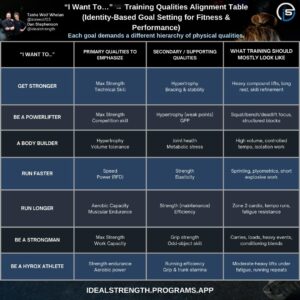
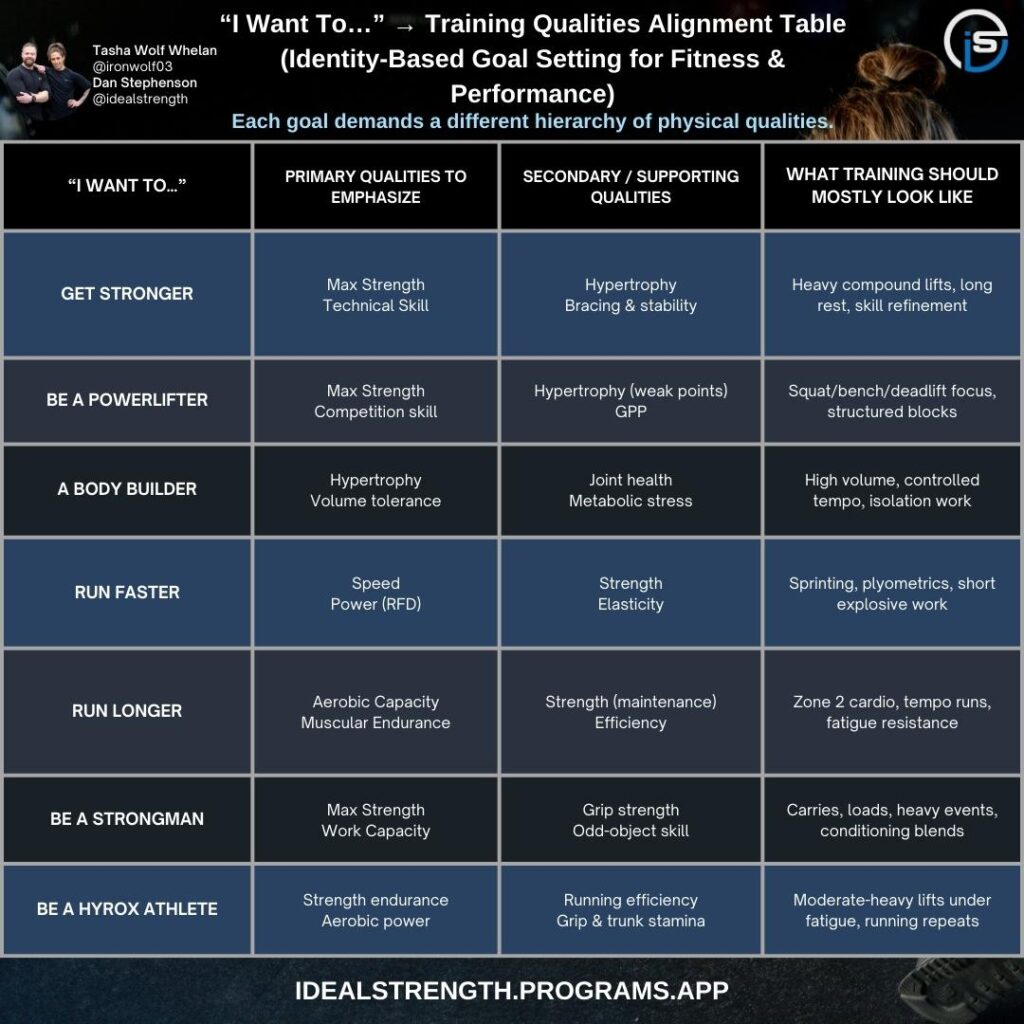
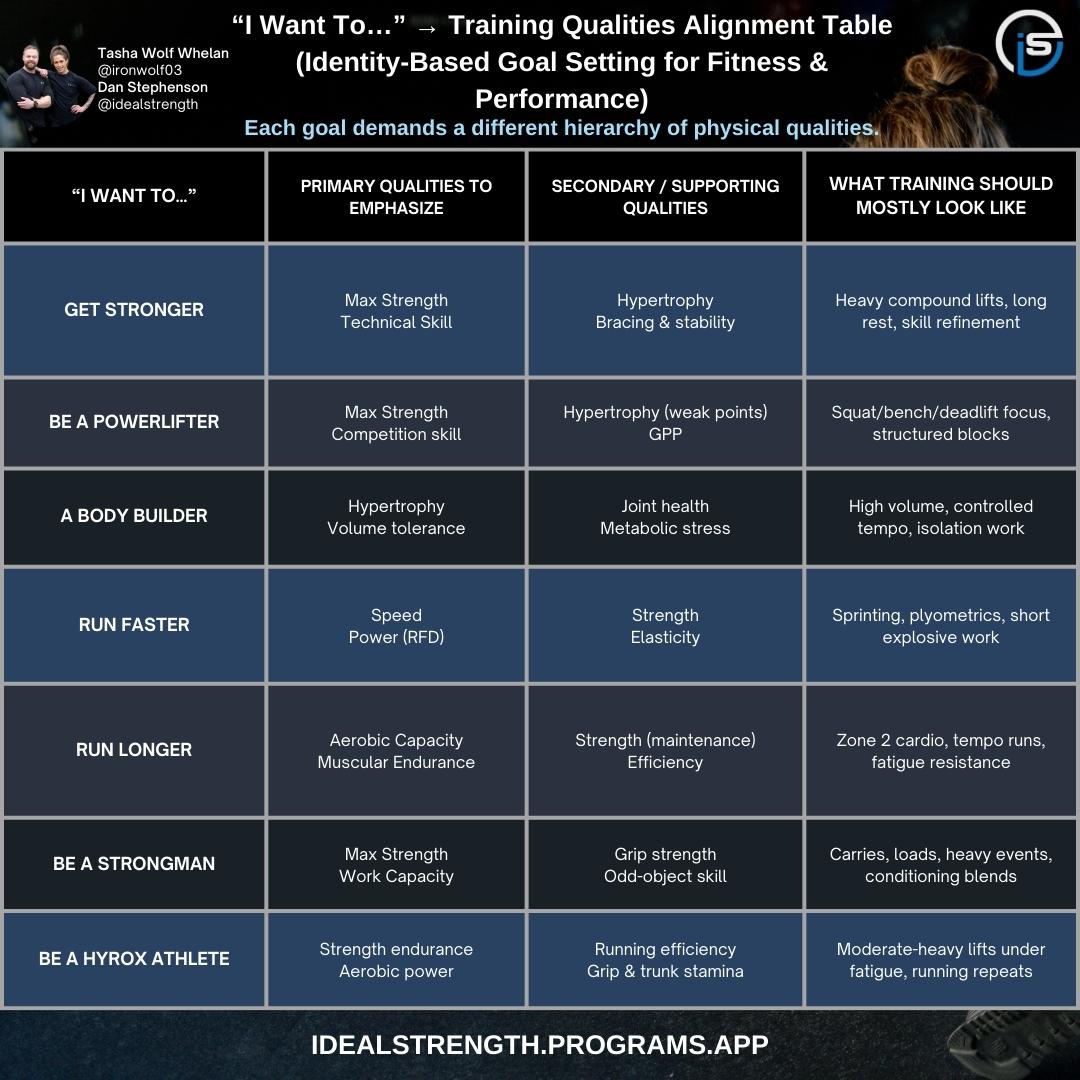
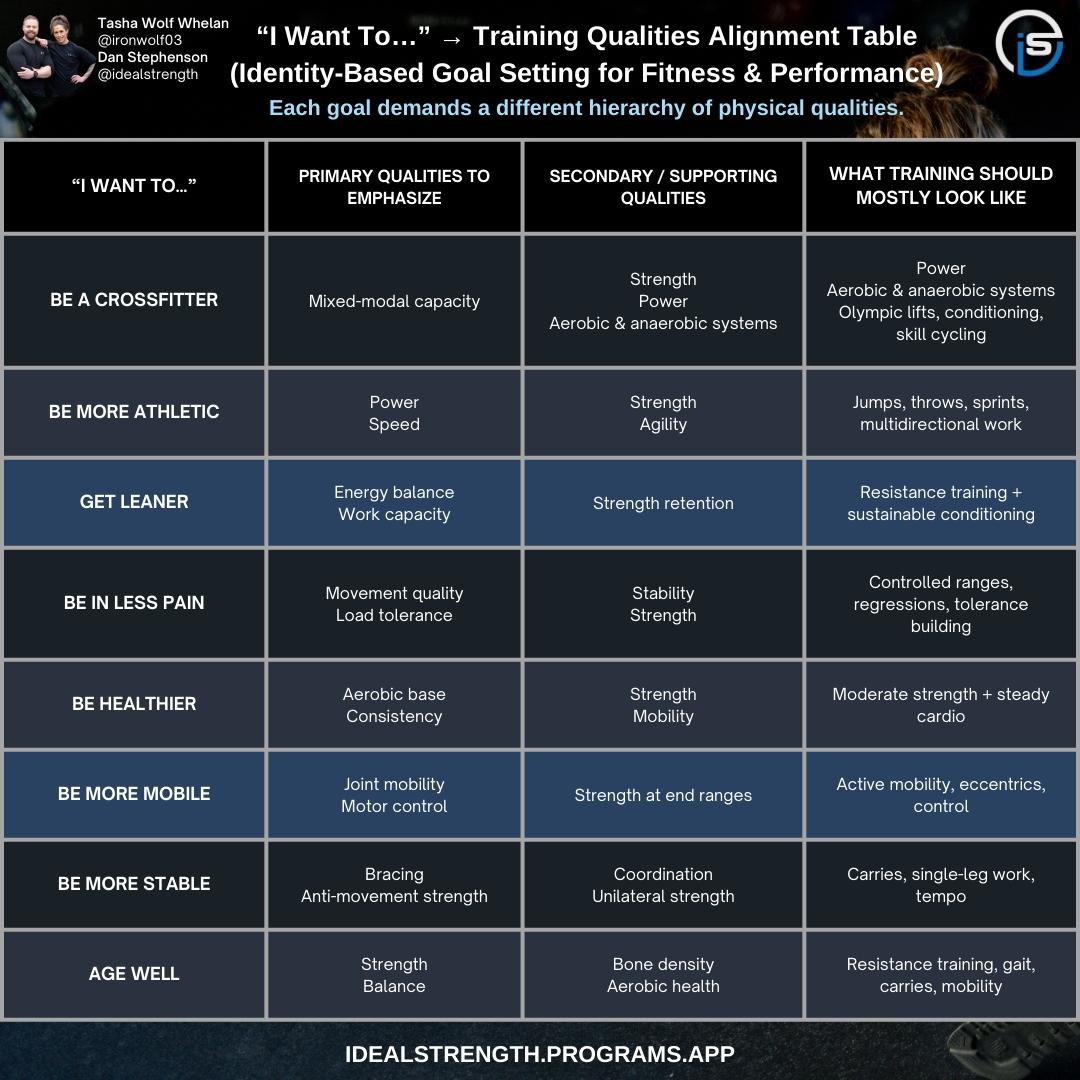
The table below shows different fitness identities and what your training should emphasize if you’re pursuing each one. This isn’t about restriction — it’s about strategic focus that actually produces results.
How to Read This Framework:
- “I Want To…”: The identity or outcome you’re pursuing
- Primary Qualities: These should receive 60-70% of your training time and energy
- Secondary Qualities: These receive 20-30% to keep you well-rounded
- What Training Looks Like: The practical reality of sessions that match this identity
Why Strategic Focus Actually Works: Three Key Insights
1. Your Body Can’t Optimize Everything Simultaneously
This isn’t a motivational talk — it’s physiology.
Building muscle vs. Building endurance: When you try to do both intensively at the same time, your body receives conflicting signals at the cellular level. High-volume endurance work interferes with the muscle-building process, especially when these workouts happen close together (within 6 hours). This is called “concurrent training interference.”
Does this mean you can’t do both? No. But it means if you’re serious about maximizing one, the other needs to take a supporting role, not an equal one.
Peaking strength vs. Maintaining high conditioning: Heavy strength training demands significant recovery. If you’re also doing intense cardio workouts, you’ll struggle to recover adequately for either. Both will suffer, leaving you with mediocre results or worse yet, burnt out.
CrossFit-style training vs. Powerlifting specialization: These require fundamentally different training stress. You can enjoy both at different times, but trying to excel at both simultaneously will leave you frustrated with progress in each.
Understanding these trade-offs doesn’t limit you — it frees you to make intentional choices about what to prioritize right now.
2. Most Training Failures Are Alignment Problems, Not Motivation Problems
Here’s an uncomfortable truth: you might be failing to stick with your program not because you lack discipline, but because your training doesn’t match the identity you’re trying to build.
Common misalignments:
- You say you want to “get stronger,” but your program emphasizes high-rep circuits and cardio and wonder why you are not progressing on your strength.
- You say you want to “run longer distances,” but you’re doing heavy squats and deadlifts three times per week and find your legs can’t keep up with the distances.
- You say you want to “move without pain,” but you’re pushing through max-effort lifts when your body isn’t ready.
When training and identity align, adherence becomes easier. You understand why you’re doing what you’re doing. Progress feels logical. The program makes sense.
3. Specificity Isn’t a Limitation — It’s How Progress Works
General health goals → You can train a wide variety of qualities simultaneously without much interference, and should! Health is the base of fitness and performance.
Specific performance identities → You must narrow your focus significantly to see real progress within one domain of performance/sport.
This is a feature, not a bug. Think of it like learning languages: you can maintain conversational ability in several languages, but becoming fluent in one requires dedicated focus on that language.
Your fitness journey works the same way.
What NOT to Prioritize: Making Peace With Trade-Offs
Understanding what to deliberately deprioritize is just as important as knowing what to emphasize.
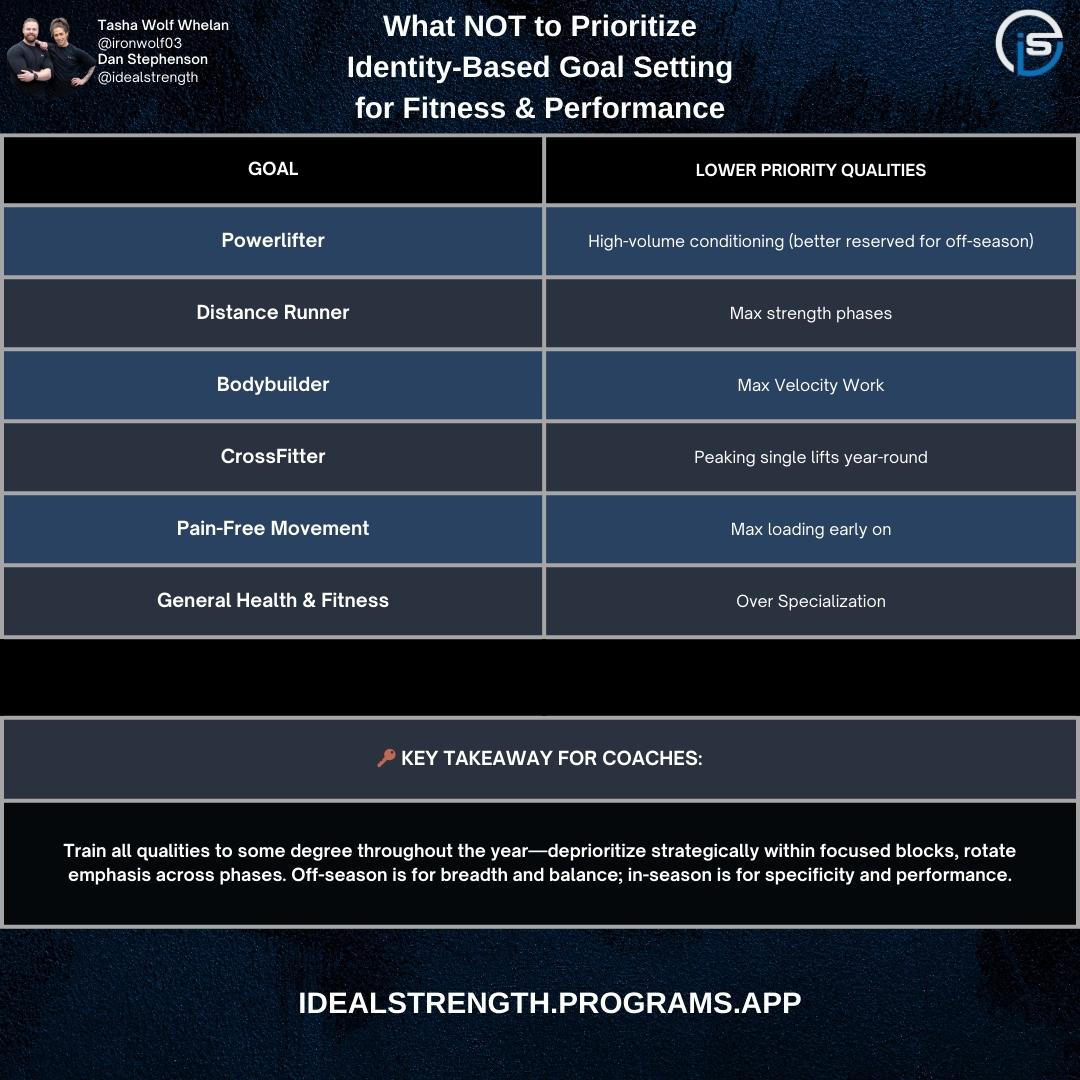
Important note: “Lower priority” doesn’t mean “never do this.” It means these qualities receive maintenance attention during focused training blocks, not equal emphasis. You’ll rotate priorities across different training phases throughout the year.
Putting This Into Practice: Sample Training Blocks
Below are detailed training blocks matched to specific identities. Use these as templates for structuring your own training based on who you’re becoming.
Building Block 1: General Strength
Your Identity: “I want to get stronger”
Duration: 4–6 weeks
Primary Focus: Building maximum strength and lifting technique
What Your Week Looks Like:
- Training frequency: 3–4 sessions per week
- Core lifts: Squat variations, deadlift/hinge patterns, pressing movements, pulling movements
- Typical sets and reps: 3–5 reps, 3–6 sets per exercise, using heavy weight
- Rest between sets: 2–4 minutes (you need this for strength)
- Cardio: Light activity like walking or easy cycling that supports recovery
What Makes This Work:
- Fewer total exercises per session (4-6 movements)
- Sessions might take longer due to rest requirements
- Every rep should feel focused and intentional
- You’re building both strength AND skill with the lifts
When to Transition:
- → If you want to focus on body composition: Keep 2 strength sessions per week, add 2-3 moderate cardio sessions
- → If you’re dealing with pain: Reduce the weight by 30-40%, focus on controlled movement speed
- → If you want athletic performance: Keep the strength foundation, add explosive movements like jumps
Building Block 2: Distance Running
Your Identity: “I want to run longer distances”
Duration: 6–10 weeks
Primary Focus: Building aerobic capacity and endurance
What Your Week Looks Like:
- Aerobic runs: 2–4 sessions per week at a conversational pace (Zone 2 – you should be able to breathe through your nose)
- One tempo run per week at a challenging but sustainable pace
- Strength training: 2 sessions per week, focusing on 2-3 main lifts to maintain muscle
- Weekly mileage increases gradually (add no more than 10% per week)
What Makes This Work:
- Consistency matters more than intensity
- Most runs should feel relatively easy
- You’re training your body to use fat as fuel efficiently
- Strength work prevents injury and maintains muscle mass
When to Transition:
- → If you want to get faster: Add sprint work and explosive training once per week
- → If you want to lose body fat: Keep the cardio base, increase resistance training sessions
- → If you want general health: Reduce total running volume by 20-30%, add more movement variety
Building Block 3: CrossFit-Style Fitness
Your Identity: “I want to be good at everything”
Duration: 4–6 weeks
Primary Focus: Mixed-modal work capacity
What Your Week Looks Like:
- Olympic lifting practice and moderate-load complexes
- Conditioning workouts: 2–4 sessions combining weights and cardio
- Strength maintained through abbreviated lifting sessions
- Gymnastics movements, barbell complexes, rowing/running/biking
What Makes This Work:
- Variety is planned, not random
- You’re training multiple energy systems
- Technical skills are practiced under fatigue
- Recovery is crucial due to high overall demands
When to Transition:
- → If you want body composition focus: Reduce workout intensity, increase consistency and sustainability
- → If you want pure strength: Remove most conditioning, focus on getting stronger at basic lifts
- → If you’re feeling burnt out: Lower overall training stress, increase rest days
Building Block 4: Muscle Building
Your Identity: “I want to build muscle”
Duration: 6–8 weeks
Primary Focus: Hypertrophy (muscle growth) and mind-muscle connection
What Your Week Looks Like:
- Training volume: 12-20 sets per muscle group per week
- Rep ranges: Mostly 8-15 reps per set
- Tempo: Slow lowering phase (3-4 seconds), controlled lifting
- Exercise selection: Mix of compound movements and isolation exercises; use machines for safety and focus
- Rest periods: 60-90 seconds between sets
- Train different muscle groups and angles (stretched, mid-range, shortened positions)
What Makes This Work:
- Focus on feeling the muscle work, not just moving weight
- Higher volume creates the stimulus for growth
- Controlled tempo maximizes time under tension
- Joint-friendly exercise selection keeps you healthy
- Minimal intense cardio preserves recovery for muscle building
When to Transition:
- → If you want to get stronger: Reduce total sets by 40-50%, increase weight significantly, rest longer
- → If you want to lean out: Keep the muscle-building sessions, add 2-3 cardio sessions
- → If you want general health: Reduce weekly sets, add steady-state cardio
Building Block 5: Athletic Performance
Your Identity: “I want to be athletic and explosive”
Duration: 4–6 weeks
Primary Focus: Power, speed, and agility
What Your Week Looks Like:
- Explosive work: Jumps (box jumps, broad jumps), medicine ball throws, sprint work
- Strength training: 2 sessions per week focusing on moving weight quickly
- Change of direction: Cutting, lateral shuffles, deceleration training
- Dynamic warm-ups: 15-20 minutes of movement preparation
What Makes This Work:
- Every rep is performed with maximum intent and speed
- Low grinding or slow, sustained effort
- You’re training your nervous system to fire rapidly
- Rest is generous to maintain quality
When to Transition:
- → If you have a specific sport: Narrow training to movements your sport requires
- → If you want longevity focus: Reduce jump volume, keep coordination work at lower intensity
- → If you want strength: Increase weight on lifts, reduce speed-focused work
Building Block 6: Pain-Free Movement
Your Identity: “I want to move without pain” / “I want to feel better”
Duration: 4–6 weeks (often ongoing with gradual progression)
Primary Focus: Movement quality and building tolerance to load
What Your Week Looks Like:
- Exercise selection: Movements within pain-free ranges only
- Isometric holds: Building strength at specific positions
- Tempo emphasis: Very slow lowering phases (4-6 seconds) to build control
- Effort level: Low to moderate (3-5 out of 10 difficulty)
- Frequency: Can train more often since intensity is lower
What Makes This Work:
- Strategic exercise modifications, not avoidance
- Slow, deliberate strength accumulation
- Consistency prioritized over pushing limits
- Building confidence in your body’s capability
When to Transition:
- → When pain improves: Gradually increase weight by 5-10% per week
- → To general health focus: Add aerobic exercise while maintaining movement quality
- → To specific weak areas: Target mobility or stability for particular joints
Building Block 7: Health & Longevity
Your Identity: “I want to be healthy and age well”
Duration: Ongoing (sustainable indefinitely)
Primary Focus: Aerobic fitness, strength maintenance, and consistent movement
What Your Week Looks Like:
- Resistance training: 2–3 sessions per week, full-body workouts
- Steady cardio: 2–4 sessions per week in Zone 2 (120-150 minutes total weekly)
- Functional movements: Walking, balance exercises, carrying objects
- Mobility work: Addressing your individual limitations
What Makes This Work:
- Sustainable stress that doesn’t compromise daily life
- Realistic time commitment you can maintain long-term
- Low injury risk through appropriate exercise selection
- Builds the foundation for a high-quality life
When to Transition:
- → To any specialized goal: Layer 4-8 week focus blocks on top of this foundation
- → After intense training phases: Return here to recover and rebuild
- → For variety: Rotate through different specializations while keeping this base
The Smart Transition Strategy: How to Change Focus Without Losing Progress
Golden Rule: Never change everything at once.
When you’re ready to shift from one training identity to another, follow this protocol:
The Four-Step Transition:
Step 1: Keep One Anchor
Maintain at least one emphasis from your previous training block. If your previous focus was on building strength, keep 1-2 strength sessions even as you add endurance work. This will be a “maintenance” dose to prevent decay in your strength.
Step 2: Change Only 1-2 Variables
Don’t simultaneously change your exercises, your rep ranges, your training days, and your cardio all at once. Modify gradually.
Step 3: Reduce Volume Before Increasing Intensity
If you’re moving to heavier, harder training, first reduce how much total work you’re doing. Let your body adapt to the new stimulus.
Step 4: Give Each Identity 4-6 Weeks Minimum
Don’t hop between training styles weekly. Adaptation takes time. Commit to a focus long enough for your body to respond.
Example Transition Sequence:
Weeks 1-6: Muscle building (high volume, moderate weight)
Transition Week 7: Reduce sets by 40%, keep same exercises
Weeks 8-12: Strength building (low reps, heavy weight, same movement patterns)
Transition Week 13: Reduce weight, add movement variety
Weeks 14-18: Athletic power (explosive movements, lower volume)
Building Your Annual Training Plan: The Big Picture Strategy
Understanding individual training blocks is valuable. But the real magic happens when you sequence those blocks strategically across an entire year.
Most people train reactively — switching focus whenever motivation strikes or a new program catches their eye. This approach leaves gains on the table and creates frustration. Social media might be partially to blame for our infatuation with the “shiny object syndrome” but that’s for another time.
A smarter approach: map out your year based on your priorities, ensuring each training block builds logically toward your most important goals.
Step 1: Prioritize Your Year’s Goals (Using SMART Criteria)
Before you can plan training blocks, you need clarity on what you’re actually working toward. This is where the SMART goal framework becomes essential:
S – Specific: “Get stronger” is vague. “Add 50 pounds to my deadlift” is specific.
M – Measurable: You need objective metrics. “Run a half marathon in under 2 hours.”
A – Achievable: Be honest about your current starting point. If you’ve never run more than 3 miles, a sub-3-hour marathon in 4 months isn’t realistic.
R – Relevant: Does this goal align with who you want to become? Does it matter to you beyond social media validation?
T – Time-Bound: “Someday” isn’t a plan. “Compete in a powerlifting meet in October” creates urgency and structure.
Realistic Self-Assessment Questions:
- Where am I starting from? (Current strength levels, endurance capacity, movement quality, injury history)
- What have I successfully achieved before? (This predicts what’s achievable in similar timeframes)
- What’s my actual available training time per week? (Be honest — 4 hours is different than 8 hours)
- What constraints exist? (Work schedule, family commitments, recovery capacity, age considerations)
Example of Realistic vs. Unrealistic Annual Goals:
Realistic for an intermediate trainee:
- Add 30-50 pounds to major lifts
- Complete first half marathon
- Build 5-10 pounds of muscle
- Achieve first unassisted pull-up
- Reduce chronic back pain to minimal levels
Unrealistic for the same person:
- Add 100+ pounds to all lifts while also training for a marathon
- Go from couch to competitive bodybuilder in 6 months
- Master Olympic weightlifting, powerlifting, and endurance simultaneously
Step 2: Identify Goal Compatibility
This is the critical insight most people miss: some goals naturally support each other, while others directly conflict.
High Compatibility Goal Pairs (Can pursue simultaneously or in short succession):
Strongman + Powerlifting
- Both require maximal strength
- Similar movement patterns (squat, hinge, press, pull)
- Strongman adds work capacity and odd-object skill
- Can train both within 6-month period with 8-12 week focus blocks
Hyrox Event + Hiking/Backpacking
- Both build aerobic endurance
- Similar muscular endurance demands
- Hyrox training naturally prepares you for long hikes
- Can pursue both within same season with slight emphasis adjustments
Muscle Building + General Strength
- Building muscle provides foundation for strength
- Similar training styles (resistance-focused)
- Can alternate 6-8 week blocks throughout year
- Each phase supports the other
CrossFit + Obstacle Course Racing
- Mixed-modal fitness transfers directly
- Similar energy system demands
- Grip and full-body strength overlap
- Compatible within same training season
Low Compatibility Goal Pairs (Require seasonal separation):
Marathon Training + Powerlifting Competition
- High-volume endurance work interferes with strength recovery
- Competing adaptations at cellular level
- Requires 3-6 month separation between peak performances
- Best approach: Dedicate spring/early-summer to marathon training, fall/early-winter to powerlifting
Bodybuilding Show + Endurance Events
- Contest prep (extreme fat loss) undermines endurance performance
- Recovery demands conflict significantly
- Muscle preservation vs. aerobic development trade-offs
- Separate by at least 4-6 months
Max Strength Peaking + High-Intensity Endurance
- CNS fatigue from both creates overtraining risk
- Recovery capacity severely compromised
- Choose one as primary, maintain other minimally
- Rotate focus across 8-12 week blocks with substantial deload between
The Compatibility Rule: The more similar the physical qualities required, the closer together you can schedule goals. The more different the qualities, the more seasonal separation you need.
Step 3: Apply Training Hierarchy Principles
Not all training qualities are created equal. Some must be established before others can be safely and effectively developed.
Universal Training Hierarchy (Build from bottom up):
Foundation Level: Movement Quality & Pain-Free Function
Before chasing performance, you must be able to move well without pain. This isn’t optional — it’s a prerequisite.
Why this comes first:
- Pain is a signal that something needs attention
- Poor movement patterns under load create injury risk
- You can’t build lasting strength on a dysfunctional foundation
- Ignoring pain now leads to forced breaks later
What this looks like:
- Address existing pain or movement limitations first
- Build control in fundamental patterns (squat, hinge, push, pull, lunge, carry)
- Establish baseline mobility where you’re restricted
- Typical duration: 4-12 weeks depending on starting point
When to move on: When you can perform basic movement patterns with control, confidence, and no pain that alters your form.
Second Level: Volume Tolerance (Work Capacity)
Once you move well, you need to build the capacity to handle training volume before you push intensity.
Why volume comes before intensity:
- Your tissues (muscles, tendons, ligaments) need time to adapt to training stress
- Jumping straight to heavy, intense work without volume preparation invites injury
- Volume builds the structural foundation that allows you to safely handle high-intensity loads later
- Think of it like building a wider base on a pyramid — it supports everything above
What this looks like:
- Moderate weights for higher rep ranges (8-15 reps)
- Building up weekly training volume gradually
- Establishing consistency (showing up 3-4x per week for several weeks)
- Typical duration: 4-8 weeks
When to move on: When you can consistently complete your planned training volume without excessive soreness, fatigue, or form breakdown.
Third Level: Intensity & Performance
Only after establishing movement quality and volume tolerance should you pursue maximum intensity and peak performance.
Why intensity comes last:
- Requires the structural resilience built through volume work
- Demands significant recovery capacity
- Higher injury risk if foundation isn’t solid
- Most effective when working from a prepared baseline
What this looks like:
- Lower rep ranges with heavier loads (1-5 reps)
- Competition-specific training
- Performance peaking blocks
- Maximum effort endurance work
- Sport-specific intensification
The Mistake Most People Make: They skip straight to intensity (heavy weights, max-effort cardio, competition training) without building the foundation. This works briefly — until it doesn’t. Then you’re forced back to square one, but now with an injury and a blow to the ego.
Step 4: Sequence Your Training Blocks Logically
Now that you understand goal compatibility and training hierarchy, you can map out an intelligent annual plan.
Annual Planning Framework:
January-March (12 weeks): Foundation Phase
- If you’re dealing with pain/limitations: Pain-free movement block (4-6 weeks) → Volume building (6-8 weeks)
- If you’re movement-ready: Volume-focused training in your primary goal area
- Purpose: Build work capacity, establish consistency, create training base
- Example: General strength with higher reps, moderate cardio for endurance goals, high-volume muscle building
April-June (12 weeks): Development Phase
- Build on foundation: Gradually increase training specificity toward your goals
- Begin intensity progression: Start working with heavier loads or faster paces
- Example: If goal is October powerlifting meet, begin strength-focused blocks with moderate intensity
- Example: If goal is to do a half marathon in the fall, increase weekly mileage while maintaining strength work
July-September (12 weeks): Specialization Phase
- High specificity: Training closely mimics your goal demands
- Manage fatigue carefully: This is higher-stress training requiring adequate recovery
- Example: For powerlifting meet, 8-week strength peak then a 2-3 week taper
- Example: For endurance event, peak mileage weeks followed by taper
October-December (12 weeks): Competition/Achievement or Transition Phase
- Option A – Goal Achievement: Peak for your main event in October/November, then recover in December
- Option B – Secondary Goal: If primary goal was earlier, pursue complementary goal here
- Option C – Maintenance: Holiday season maintenance, prepare for next year’s focus
- Recovery is productive: Taking 2-4 weeks of lower-intensity training after a peak isn’t “losing progress”
Step 5: Real-World Annual Plan Examples
Example 1: Powerlifting Meet + Muscle Building (Compatible Goals)
Starting Point: Can train consistently 4x/week, cleared for all movements, previous training experience
- January-February (8 weeks): Hypertrophy block – build muscle base, 12-20 sets per muscle group weekly
- March-April (8 weeks): General strength block – reduce volume, increase load to 3-5 rep ranges
- May-July (12 weeks): Powerlifting-specific block – competition lift focus, planned intensity waves
- August (4 weeks): Competition peak and taper – highest intensities, reduced volume
- September: Compete in powerlifting meet
- October (4 weeks): Active recovery and movement variety
- November-December (8 weeks): Return to hypertrophy block to build muscle for next year
Why this works: Muscle building early in the year creates foundation. Strength and power builds naturally progress toward meet. Post-competition recovery, then return to muscle building for the next cycle.
Example 2: Half Marathon + General Fitness (Compatible Goals)
Starting Point: Can run 3 miles comfortably, some strength training experience, no significant injuries
- January-February (8 weeks): Build aerobic base – Zone 2 running 3-4x/week, maintain strength 2x/week
- March-April (8 weeks): Increase weekly mileage – add tempo runs, continue strength maintenance
- May (4 weeks): Peak mileage weeks with long runs building to 11-12 miles
- June (2 weeks): Taper – reduce volume, maintain intensity in shorter runs
- Late June: Half marathon race
- July (4 weeks): Active recovery – easy running, increase strength training
- August-October (12 weeks): Strength and muscle building focus – 3-4 resistance sessions weekly, maintain 2x easy runs
- November-December (8 weeks): General fitness maintenance and variety
Why this works: Endurance goal in first half of year. Recovery period. Then shift focus to strength/muscle development for the latter half. Maintains both qualities year-round but emphasis rotates.
Example 3: Marathon + Powerlifting (Conflicting Goals – Requires Seasonal Approach)
Starting Point: Intermediate in both strength and endurance, must choose primary focus per season
- January-February (8 weeks): Build running base – high mileage weeks, strength reduced to 1-2 maintenance sessions
- March-May (12 weeks): Marathon-specific training – peak mileage, tempo runs, long runs progressing to 20+ miles
- Late May: Marathon race
- June (4 weeks): Full recovery – easy movement, no structured training
- July-August (8 weeks): Rebuild strength foundation – volume-focused lifting, minimal running (2-3 miles 2x/week)
- September-November (12 weeks): Powerlifting-specific training – heavy loads, competition prep
- December: Powerlifting meet, then active recovery
Why this works: Recognizes these goals fundamentally conflict. Dedicates entire seasons to each. Complete recovery between. Maintains minimal work in off-quality to prevent total detraining. Might be difficult to see progress in either sport even given the longer prep-cycle, but it can be done.
Example 4: Starting From Pain/Dysfunction
Starting Point: Chronic knee pain, hasn’t trained consistently in 12+ months, wants to eventually run 10K
- January-February (6-8 weeks): Pain-free movement focus – daily mobility, bodyweight to loaded progressions involving controlled tempos, pain-free cardio options (cycling, swimming)
- March-May (12 weeks): Volume building – increase training frequency to 3-4x/week, progressive resistance training, introduce walk/run intervals if pain-free
- June-July (8 weeks): Running base building – if cleared, build to 20-30 minutes continuous easy running 3x/week
- August-October (12 weeks): Structured 10K training plan – gradual mileage increase
- November: 10K race
- December: Recovery and planning next year’s focus
Why this works: Respects training hierarchy. Spends adequate time building a foundation. Does not rush into performance training. By November, has eliminated pain AND achieved the initial goal.
Key Principles for Annual Planning:
- Start where you actually are, not where you wish you were
- Respect the training hierarchy: Movement quality → Volume → Intensity
- Group compatible goals together; separate conflicting goals by seasons
- Plan recovery periods after intense training phases (4-8 weeks minimum)
- Each 4-6 week block should have ONE primary emphasis
- Maintain (don’t eliminate) secondary and tertiary qualities during focused blocks
- Build volume before adding intensity — always
- Allow 8-12 weeks minimum per major goal
What About Flexibility?
Life happens. Injuries occur. Motivation fluctuates. Your annual plan isn’t a contract—it’s a roadmap.
When to adjust:
- Unexpected injury or pain emerges (return to movement quality focus)
- Life stress increases significantly (reduce training intensity/volume)
- A new opportunity arises (race, competition, adventure)
- You’re consistently missing workouts (program may be too aggressive)
What to keep consistent:
- The principle of building volume before intensity
- Adequate recovery after intense training blocks
- Addressing pain/movement issues before pushing performance
- Focusing on one primary quality per 4-6 week block
Next month, we’ll dive deeper into advanced periodization strategies: how to structure training waves within blocks, when to deload, how to peak for specific events, and managing multiple training qualities simultaneously when you’re more advanced.
For now, understanding these foundational principles — training hierarchy, goal compatibility, and logical sequencing — will put you ahead of 90% of people who train reactively instead of strategically.
Your Action Plan: From Confusion to Clarity
Most people don’t need a more complicated program. They need clarity about who they’re training to become.
Ask Yourself:
- Who am I training to be right now? (Pick ONE from the identities above)
- What does my training actually emphasize? (Be honest—does it match your answer to #1?)
- What needs to be deprioritized temporarily? (What are you willing to put on maintenance mode?)
- How long will I commit to this focus? (Minimum 4-6 weeks)
Your Implementation Checklist:
- [ ] Choose one training identity from this article
- [ ] Review your current program against the recommended priorities
- [ ] Identify misalignments (where your training doesn’t match your stated identity)
- [ ] Plan your next 6-week training block using the appropriate template above
- [ ] Schedule when you’ll reassess and potentially shift focus
The Bottom Line
You can’t maximize everything simultaneously. But you can systematically build toward multiple qualities over time by strategically rotating your focus across different training blocks throughout the year.
General fitness enthusiasts can maintain broad capabilities. But if you want to truly excel at something, whether that’s lifting heavy, running far, or moving pain-free, you need to commit to that identity for a focused period.
When your training aligns with who you’re becoming, everything gets easier:
- You know why you’re doing what you’re doing
- Progress feels logical and achievable
- You stop second-guessing every workout
- Results actually compound
The question isn’t “What workout should I do today?”
The question is: “Who am I training to become?”
Answer that, and your training decisions become obvious.
Need Some Help Tackling Your Goals?
Building an intelligent training plan is one thing. Executing it consistently with proper technique and smart adjustments is another.
Explore the Ideal Strength Training App – Access proven training programs designed around specific identities and goals. Whether you’re building strength, training for endurance, or focusing on muscle growth, you’ll find structured programs that follow the principles outlined in this article.
Ready for a fully customized approach? Apply for individualized coaching and work directly with our team to design, implement, and adjust your training plan based on your unique starting point, goals, and lifestyle.
Want more evidence-informed training frameworks delivered monthly? Sign up for Trainer Edge – our newsletter for those committed to training smarter, not just harder.